 Air Conditioning & Heating Service.Air Conditioning & Heating Service.
Comfortable through every Michigan season.
Looking for an air conditioning contractor in Ferndale to fix a unit that quit, tune one up before the heat, or price a full replacement? This crew handles central AC, ductless mini-splits, and heat-pump systems for houses from the Lower West Side to East Ferndale, and every visit starts with a real diagnosis instead of a guess. Cooling work near me searches spike here the first week the humidity settles over Southeast Michigan, and same-day repair slots go fast once that first heat wave hits.
📞 Call (313) 552-8114
Text or call about your air conditioning contractor job — a quick photo helps us quote fast.
A firm, all-in price confirmed before we start — no surprises.
On time, done to standard, and tidy when we leave.
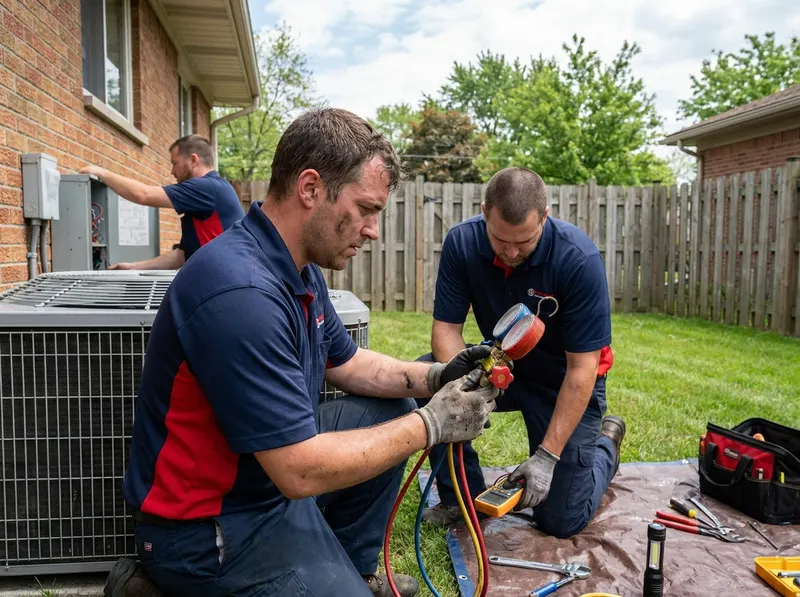
Central AC repair makes sense when the system is worth keeping — generally a unit under 12 to 15 years old with one clear failure, not a compressor that has already died on an aging R-22 setup. A capacitor or contactor replacement on a 6-year-old condenser is an easy call. When a much older system needs a compressor or a major refrigerant repair, replacement often costs less over time, and a technician will lay out both numbers so the choice is yours. The trade-off is straightforward: repair is cheaper today, but a tired system may need another fix next summer.
Ferndale's housing stock shapes the repairs we see most. The bungalows and older two-stories across the Ferndale Lower West Side and Woodward Heights often run condensers squeezed into narrow side yards, where trapped heat and cottonwood fluff from mature trees clog coils and push run capacitors past their limit. Homes near the Livernois corridor area and the Wanda-Vester area frequently have systems that were added to houses built before central air was standard, so undersized line sets and long duct runs are common culprits behind weak cooling. Around Downtown Ferndale and the Nine Mile District, tighter lots mean condensers sit close to pavement and fences that reflect heat, which is hard on fan motors during a July stretch.
Diagnosis comes first on every call. The technician confirms the failure — measuring capacitor microfarads, checking contactor contacts, reading refrigerant pressures, and inspecting the condensate line and float switch — before quoting a fix. If a unit near East Ferndale or the Ferndale Upper West Side keeps tripping, the cause could be a failing motor, a dirty coil, or an electrical fault, and each carries a different price. On a hot Oakland County afternoon a slow-draining condensate line can shut a system down entirely, and that clear is usually quick. Honest framing matters: the ranges below are ballparks, and the exact price is confirmed on-site after the actual fault is found.
| Diagnostic / service call (minimum) | $150 |
| Run capacitor replacement | $180 - $350 |
| Contactor replacement | $180 - $320 |
| Condensate drain clear | $150 - $275 |
| Condenser fan motor replacement | $400 - $750 |
| Refrigerant leak repair + recharge | $450 - $1,200+ |
Most central AC repairs in Ferndale are finished in one visit once the failing part is identified. Common stocked parts like capacitors and contactors are typically replaced the same day; specialty motors may need a short order.
A central AC in Ferndale that trips the breaker usually points to a failing compressor start component, a shorting fan motor, or an overloaded circuit. A technician measures the electrical draw during startup to pinpoint the cause before replacing anything.
For older Ferndale houses in areas like the Lower West Side, repair is the better value when the system is under about 12 years old with a single fault. When an aging unit needs a compressor or major refrigerant work, we compare both costs so you can decide.
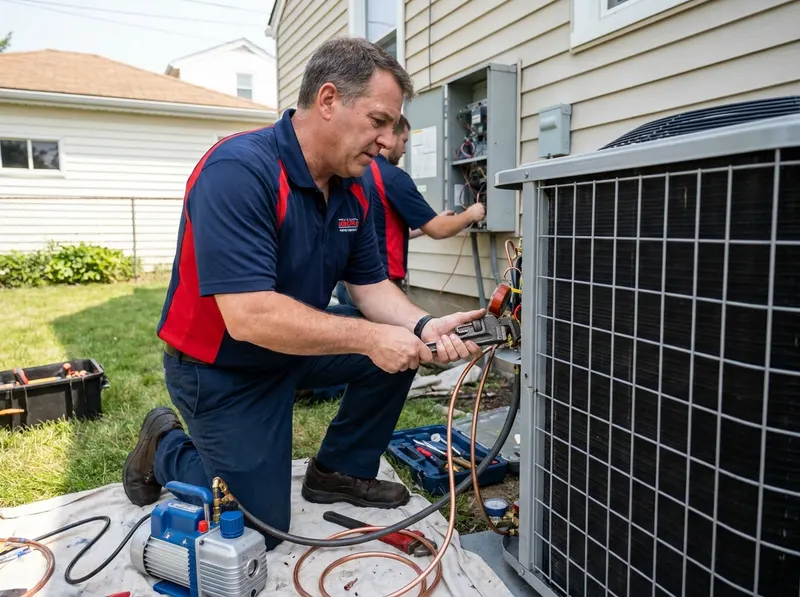
Ferndale's housing mix drives most replacement decisions. Many homes on the Ferndale Lower West Side and around the Wanda-Vester area are pre-1950 bungalows and colonials with retrofitted ductwork, tight side yards, and older electrical panels. On those properties an oversized condenser short-cycles and never dehumidifies well, so correct sizing (a Manual J load calculation rather than matching the old nameplate) matters more than raw tonnage. Newer builds and renovated homes near East Ferndale and the Nine Mile District often have room for a higher-efficiency variable-speed system that pays back over Michigan summers.
Replacement fits when repair costs stack up or the unit uses R-22 refrigerant, which is no longer produced and expensive to recharge. A single failed capacitor or contactor is a repair, not a replacement. But a compressor failure, a leaking coil on a 12-to-15-year-old unit, or a system that can't hold up through a humid July stretch is a strong replacement candidate. The trade-off is upfront cost versus years of rising repair bills and higher energy use; a new right-sized unit lowers both. We walk through both paths on the free visit so the choice is yours.
Access shapes the job in older Ferndale neighborhoods. Homes along the Livernois corridor area and Ferndale Upper West Side frequently have condensers wedged into narrow side setbacks near the neighbor's lot line, which affects clearance and airflow for the new unit. We check panel capacity, disconnect location, and pad condition before quoting, because an undersized breaker or a cracked pad adds to a job that looked simple from the curb. For homes near Geary Park and Woodward Heights we confirm the existing line-set is clean and compatible before reusing it, since a flushed or replaced line-set protects the new compressor.
Every replacement is measured to your home, not sold from a catalog. That means confirming duct static pressure, return sizing, and thermostat compatibility so the new system performs the way its rating promises. Oakland County permit and inspection requirements are handled as part of the install where applicable.
| Diagnostic / service visit (minimum) | from $150 |
| Standard central AC replacement (matched condenser + coil) | $4,500-$6,500 |
| High-efficiency / variable-speed replacement | $6,500-$8,500 |
| Line-set replacement (if required) | $400-$900 added |
| Electrical / disconnect upgrade (if required) | $250-$700 added |
Most Ferndale central AC replacements are completed in a single day. Homes with tight side-yard access on the Lower West Side or added electrical work may run into a second visit, which we flag during the free on-site assessment.
A full central AC replacement in Ferndale typically ranges $4,500-$8,500 depending on system size and efficiency. This is a ballpark; the exact price is confirmed on-site after we measure your home and check ductwork and electrical. Our minimum charge for any visit is $150.
Replace when the unit is 12-plus years old, uses R-22 refrigerant, or needs a repair costing more than half a new system. Repair makes sense for a single failed part on a newer unit. On the free Ferndale visit we lay out both costs so you decide.
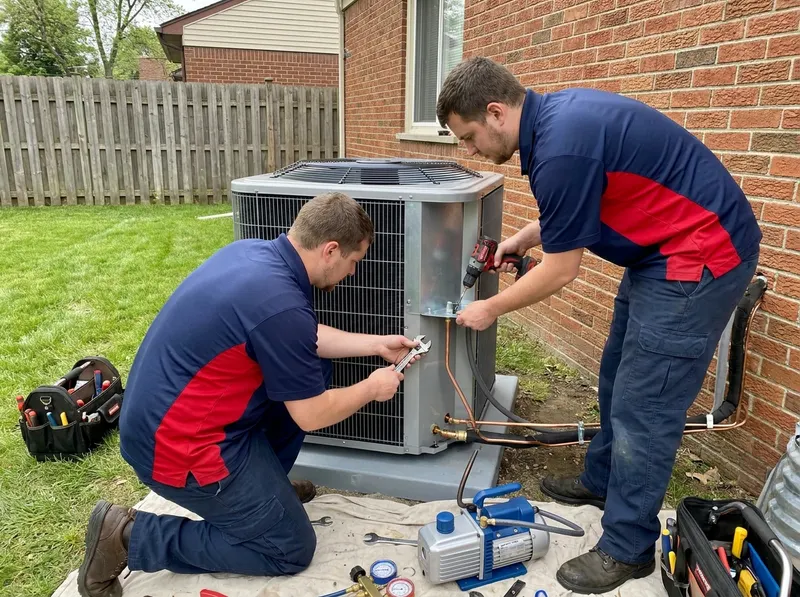
Ferndale's housing stock leans heavily toward 1920s and 1940s bungalows and Cape Cods, especially across the Lower West Side and Woodward Heights. Many of these homes were never built for central air, so a new AC installation often means adding a system rather than swapping one out. That changes the job: line-set routing, condensate drainage, and finding a discreet spot for the outdoor unit on a narrow lot all factor into the plan. We size the system to the actual home using square footage, insulation, and window exposure — not a rule-of-thumb guess that leaves you with an oversized unit that short-cycles and never dehumidifies properly.
A new installation is the right call over repair when the existing condenser is 12 to 15 years old, uses discontinued R-22 refrigerant, or has a failed compressor. Repairing a system that old usually means paying for a fix that buys a single season. A fresh install with a modern high-efficiency unit lowers summer electric bills and restores even cooling — a real difference in the taller two-story homes near the Nine Mile District and East Ferndale, where upper floors tend to run hot. If your current system is under 10 years old and the problem is isolated, a repair is the smarter spend, and we'll say so.
Homes near the Livernois corridor and the Upper West Side sit on compact lots, so condenser placement matters for both airflow clearance and Ferndale's setback and noise considerations. We plan for adequate space around the outdoor unit and route line sets to keep the exterior clean. For homes without existing ductwork — common among older Downtown Ferndale properties — a ductless mini-split may be the better fit than forced-air central, and we'll walk through both options on-site before you commit to anything.
Every quote starts with a free on-site visit. Prices below are honest ballparks; the exact figure depends on the equipment you choose and what your home needs. Serving all of Ferndale and greater Oakland County, from the Wanda-Vester area to Woodward Heights. Call (313) 552-8114 to get on the schedule.
| Central AC install (existing ductwork, standard efficiency) | $3,800 - $6,000 |
| Central AC install (high-efficiency unit) | $5,500 - $8,500 |
| Ductless mini-split, single zone | $3,500 - $5,500 |
| On-site assessment / diagnostic minimum | from $150 |
Most new AC installations in Ferndale finish in one full day when ductwork already exists. Adding a system to an older Lower West Side or Woodward Heights home without ducts can extend into a second day due to line-set and electrical work.
Yes. Many Downtown Ferndale and Upper West Side bungalows were built without ducts, so we assess whether forced-air central AC or a ductless mini-split fits your home better. We review both options during the free on-site visit.
The correct size for a Ferndale home depends on square footage, insulation, and window exposure — not just tonnage guesswork. We calculate the actual cooling load on-site so the system dehumidifies properly instead of short-cycling.
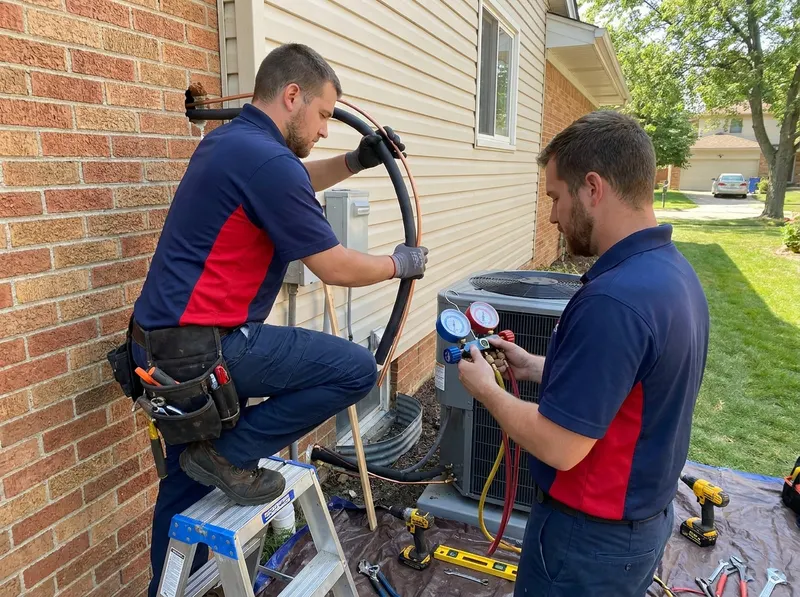
A ductless mini-split fits Ferndale housing stock well because so much of it predates central air. Many Ferndale Lower West Side and Woodward Heights homes are pre-war frame houses with plaster walls and no place to hide ducts, and a mini-split solves that with a three-inch wall penetration instead of a demolition project. Finished attics near the Wanda-Vester area and bonus rooms over garages in East Ferndale are also strong candidates, since a single head can condition a space the main furnace and existing ducts never reached.
Choose ductless over a conventional central system when adding ductwork would mean tearing into finished ceilings, when you are cooling one or two problem rooms rather than a whole house, or when a home addition needs its own independent zone. The trade-off is visible indoor heads and a higher per-ton equipment cost than a basic window unit. In exchange you get quiet operation, room-by-room temperature control, and a system that also delivers heat down into cold Oakland County winters, which a window air conditioner cannot do. If your home already has good ductwork and a working furnace, a central AC tie-in is usually the more economical path, and we will tell you that during the visit.
Zone planning matters most in multi-story Ferndale homes. A Downtown Ferndale two-story near the Nine Mile District often does best with a head on each floor rather than one oversized unit fighting the stairwell. For the Ferndale Upper West Side and Livernois corridor area, we size the condenser to the combined load of the heads and confirm the electrical panel can carry the new dedicated circuit before install day. Placement of the outdoor unit is chosen for service access and to keep it clear of tight side-yard setbacks common on older Ferndale lots.
Every quote starts with a free on-site assessment because room dimensions, insulation, sun exposure, and existing electrical capacity all move the number. We measure the actual space, check the panel, and map the line-set route so the ballpark you get reflects your house, not a generic estimate.
| Minimum service/diagnostic charge | from $150 |
| Single-zone mini-split installed | $3,500-$6,000 |
| Two-zone system installed | $6,000-$9,500 |
| Three-zone and larger multi-zone | $9,500+ |
| Additional indoor head (added to system) | $1,200-$2,500 |
Yes. Ductless mini-splits in Ferndale run in heat-pump mode and provide heating through Oakland County winters, though many homeowners keep a furnace as backup for the coldest stretches.
Ductless is often the best fit for older Ferndale Lower West Side houses because it needs only a small wall penetration instead of new ductwork, which preserves plaster walls and original ceilings.
Most Downtown Ferndale two-story homes are served well by one head per floor or per major room; the exact count depends on square footage and layout, confirmed during the free on-site visit.
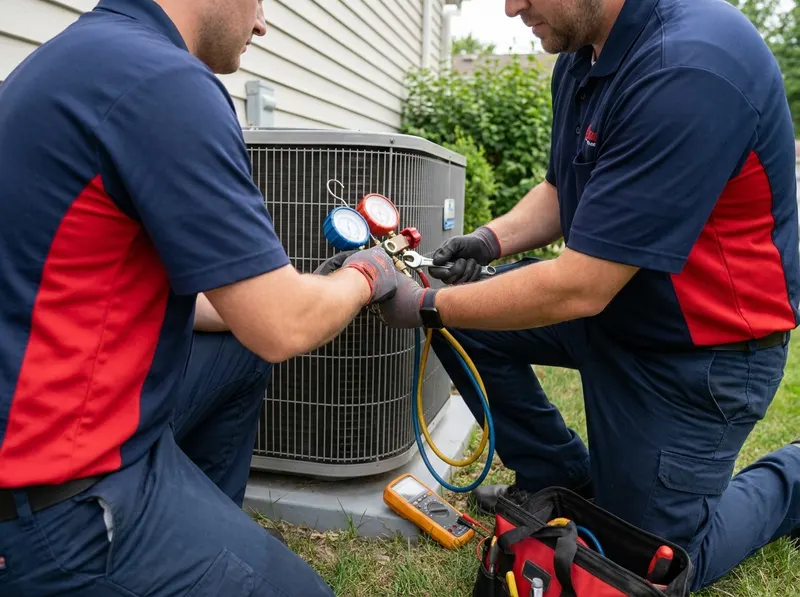
Maintenance fits homes that already have a working AC and want to prevent mid-summer failures. A tune-up is the right call when the system runs but hasn't been serviced in over a year, when energy bills climb without a clear reason, or when cooling feels weaker on the top floor of an older Ferndale Lower West Side bungalow. The alternative — waiting for a breakdown — usually costs more, since a neglected capacitor or clogged coil often fails on the hottest day. The trade-off is straightforward: a scheduled visit is a small planned cost that reduces the odds of an emergency repair call.
Ferndale's housing stock shapes what a tune-up finds. Many homes near Downtown Ferndale and the Nine Mile District were built decades ago and run condensers tucked into narrow side yards or along the property line, where leaves and grass clippings collect on the coil. Homes in Woodward Heights and the Wanda-Vester area often pair aging ductwork with newer condensers, so airflow testing matters as much as the outdoor unit. On the Livernois corridor and in East Ferndale, tighter lots mean condensers sit close to fences and walls, which restricts airflow and makes coil cleaning and clearance checks a routine part of the visit.
Spring is the practical window for maintenance in Oakland County, before the first stretch of 90-degree days pushes systems hard. A pre-season tune-up catches low refrigerant, a weak start capacitor, or a partially blocked condensate drain while there's still time to address it calmly. For rental units and duplexes common across the Ferndale Upper West Side, a documented annual visit also helps landlords track system condition between tenants. Every visit ends with plain notes on what was checked and what, if anything, needs attention.
A tune-up is inspection and cleaning, not a repair. If the visit uncovers a failed part or a refrigerant leak, that work is quoted separately and confirmed before anything proceeds. Bundling a tune-up with a repair on the same trip usually saves a second service fee.
| Standard single-system AC tune-up | $150–$220 |
| Two-system or multi-zone maintenance | $250–$400 |
| Tune-up with condenser coil deep clean | $200–$300 |
| Seasonal maintenance visit (pre-summer) | from $150 |
Once a year is the recommended schedule for AC maintenance in Ferndale. Spring, before Oakland County's hot stretches begin, is the ideal time so any issue is found before peak demand.
An AC tune-up in Ferndale includes condenser coil cleaning, refrigerant pressure readings, electrical component checks, thermostat calibration, condensate drain clearing, and airflow measurement. Older homes near Downtown Ferndale often need extra attention to coil clearance and ductwork.
A clean, correctly charged system runs more efficiently, which can reduce cooling costs. Maintenance won't overcome undersized ductwork common in some Woodward Heights homes, but it removes the efficiency losses caused by dirty coils and low refrigerant.
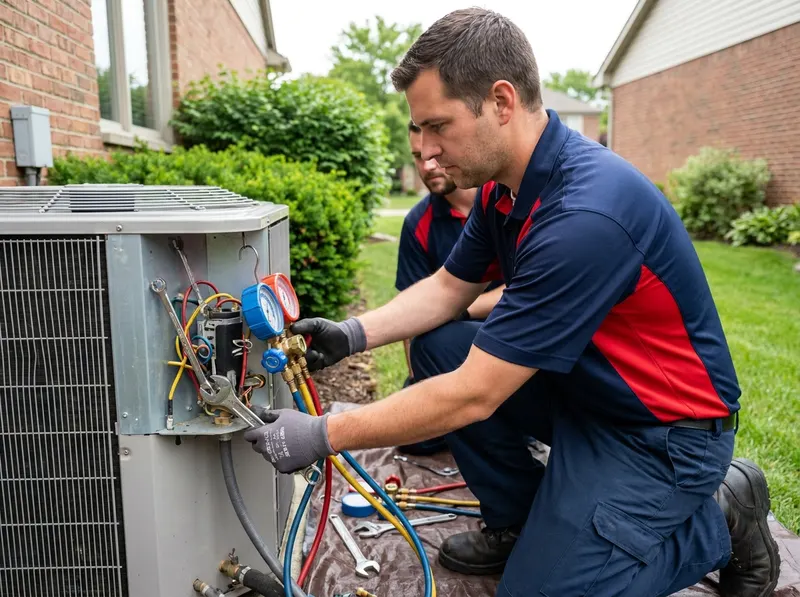
An emergency call is the right choice when your home is heating up fast and waiting days is not an option. Common no-cool causes in Ferndale homes include a failed run capacitor, a burned contactor, a frozen evaporator coil, or a tripped breaker that keeps resetting. A capacitor swap is a quick fix; a compressor failure is a much larger conversation. The technician confirms which category you are in before anything is charged beyond the diagnostic, so you are never guessing about scope.
The housing stock around Ferndale shapes what breaks. The older bungalows and colonials across the Ferndale Lower West Side and Woodward Heights often run condensers that are a decade or more old, where capacitors and fan motors age out first. Homes near the Livernois corridor area and the Wanda-Vester area sometimes have condensers tucked into tight side yards where debris and cottonwood buildup restrict airflow and cause overheating shutoffs. In Downtown Ferndale and along The Nine Mile District, upper-unit and rear-lot condensers can be harder to reach, which is worth mentioning when you call so the crew arrives ready.
Emergency repair fits when the failure is a defined part and the system is otherwise sound. If the unit is well past its service life and the failed part is the compressor, a repair may only buy a short window, and a planned replacement conversation makes more sense than an emergency patch. That trade-off is laid out on-site with the actual condition in front of you, not assumed over the phone. For homes in East Ferndale and the Ferndale Upper West Side, where summer humidity can spike quickly, restoring even basic cooling the same day is usually the priority regardless of the long-term plan.
The honest framing on cost: the numbers below are ballparks. The exact figure is confirmed on-site once the technician identifies the failed component, because a $150 diagnostic on a simple capacitor and a major electrical repair are very different jobs. You approve the price before the wrench turns.
| Emergency diagnostic / minimum service charge | from $150 |
| Capacitor or contactor replacement | $150–$400 |
| Fan motor replacement | $400–$800 |
| Refrigerant leak diagnosis and recharge | $300–$900+ |
| Frozen coil clear and airflow correction | $150–$450 |
Same-day dispatch is the goal for Ferndale emergency calls, with a dispatch window given when you phone. During Oakland County heat waves, no-cool calls are prioritized. Call (313) 552-8114 and describe the symptom so the crew arrives with likely parts.
Emergency AC repair in Ferndale starts at a $150 minimum service charge covering the diagnostic. Simple fixes like a capacitor run to the low hundreds, while motor or refrigerant work runs higher. The exact price is confirmed on-site and approved before any repair begins.
A breaker that trips repeatedly on a Woodward Heights AC unit signals an electrical fault or a straining compressor and should be checked promptly rather than reset again and again. Stop resetting it and call for a same-day diagnosis to avoid further damage.
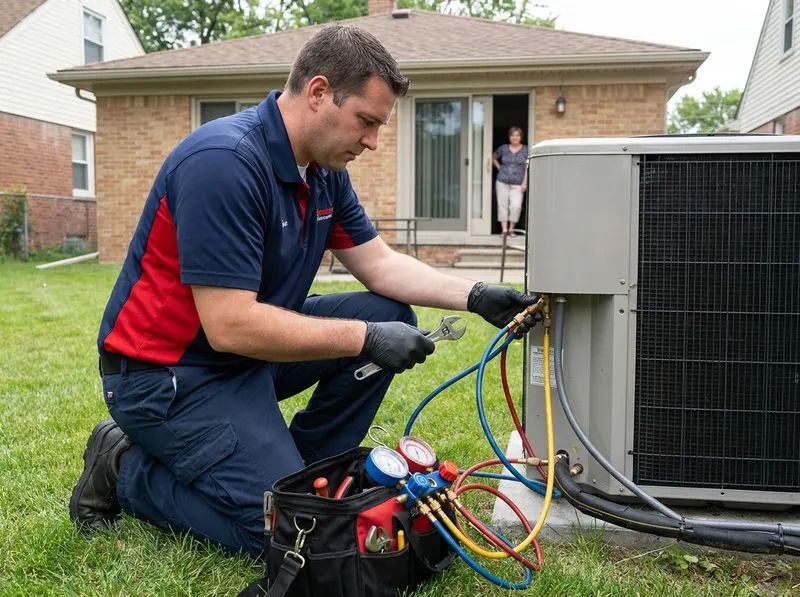
Heat pumps behave differently than furnaces, and Ferndale's climate is exactly where that difference shows up. When temperatures drop near or below freezing, an air-source heat pump has to run its defrost cycle to clear frost off the outdoor coil, and it may lean on backup electric or gas heat. If your unit is icing over solid, blowing lukewarm air, or running nonstop on a cold Woodward Heights morning, those are the symptoms heat pump service is built to diagnose. A proper visit checks the reversing valve, defrost board, sensors, and refrigerant charge rather than just topping off refrigerant and leaving.
Heat pump service makes sense when your existing system is worth keeping and the problem is a specific fault: a weak capacitor, a stuck reversing valve, a low charge from a slow leak, or a defrost sensor that's misreading. The alternative is full replacement, which only pencils out when the compressor has failed, the system is well past its service life, or repair costs approach the price of a new unit. The honest trade-off is age and repair cost versus efficiency gains from newer equipment. For many Ferndale homes in the Lower West Side and East Ferndale with a heat pump under ten years old, targeted repair and a seasonal tune-up is the cheaper, sensible path.
Older Ferndale housing stock around the Nine Mile District and the Livernois corridor area often pairs a heat pump with tight duct runs or a converted setup, so airflow matters as much as refrigerant. We verify static pressure and coil cleanliness because a starved airflow makes a healthy compressor look broken. Ductless mini-split heat pumps, which are common retrofits in Downtown Ferndale bungalows and additions near Geary Park, get their own attention: filter and blower-wheel cleaning, drain-line checks, and outdoor-unit clearance so snow off the driveway doesn't smother the coil.
Seasonal maintenance is where heat pumps pay you back. Because the same unit runs both summer and winter in the Upper West Side and Wanda-Vester area, it logs far more hours than a cooling-only system, so twice-yearly checks catch small refrigerant losses and electrical wear before a January no-heat call. If you're near Wilson Park or Martin Road Park and noticed higher bills last winter, a charge and defrost inspection is usually the first thing worth doing.
| Heat pump diagnostic / service call | $150+ (minimum charge) |
| Seasonal tune-up (single system) | roughly $150–$250 |
| Capacitor or contactor replacement | roughly $200–$400 |
| Defrost board or sensor repair | roughly $300–$650 |
| Refrigerant leak search and recharge | roughly $400–$900+ depending on charge and repair |
| Reversing valve replacement | roughly $700–$1,600+ depending on system |
Light frost on a Ferndale heat pump is normal and clears on the defrost cycle, but solid ice usually means a defrost sensor, board, or reversing-valve fault, or low refrigerant. A service visit tests the defrost cycle directly instead of just scraping the ice.
Yes. We service ductless mini-split heat pumps throughout Ferndale, including retrofits in Downtown Ferndale and additions near Geary Park, covering filter and blower cleaning, drain lines, refrigerant checks, and outdoor-unit clearance.
Heat pump service in Ferndale starts at a $150 minimum for a diagnostic call, with repairs quoted after inspection. These are ballpark ranges; the exact price is confirmed on-site once we've identified the fault.
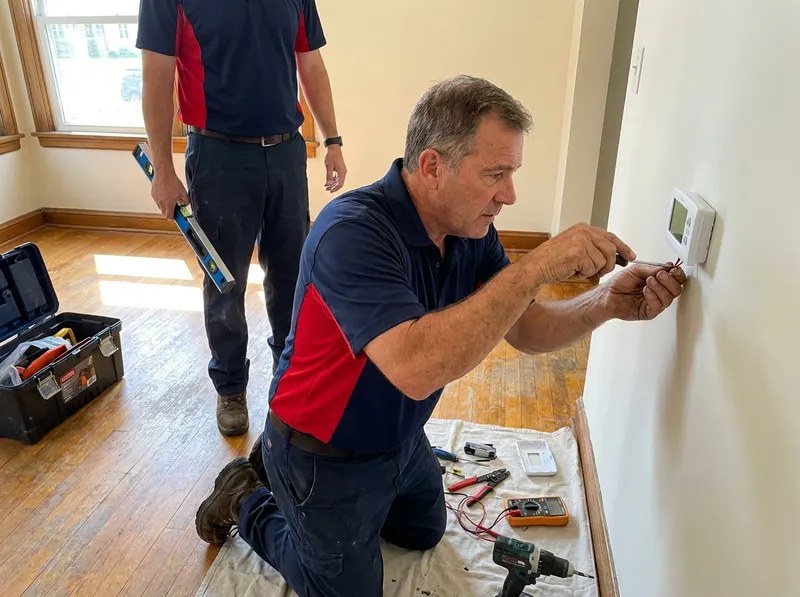
A thermostat swap fits when your current unit reads wrong temperatures, won't hold a setpoint, or you're moving to a smart model for scheduling and remote control. Older Ferndale homes on the Lower West Side and around the Wanda-Vester area often still run mechanical or early digital thermostats, and many of those lack the C-wire (common wire) that modern smart units like Nest and ecobee need for steady power. Confirming whether a C-wire exists is the first step; if it's missing, options include running a new wire, using a manufacturer power adapter, or fitting a model that works without one. This is where a quick on-site check saves guesswork.
A standard programmable thermostat is the better call when the goal is a reliable schedule at a lower cost, or when the furnace is older and doesn't benefit from smart features. A smart thermostat makes more sense for homeowners near Downtown Ferndale and the Nine Mile District who want app control, energy reporting, and integration with the rest of the house. The trade-off is straightforward: smart units cost more up front and depend on solid Wi-Fi, while programmable units are cheaper and simpler but offer no remote access. Both are valid; the right choice depends on the system and how you actually use it.
Compatibility matters more than brand. Homes near the Livernois corridor and East Ferndale with multi-stage or heat-pump systems need a thermostat rated for those stages, and a mismatched unit can leave heating or cooling stuck on one mode. Every install includes a function test of both heat and cool before we leave, so a thermostat set up for a two-story place off Woodward Heights actually controls the system the way it should. Wiring is labeled and photographed before disconnecting the old unit to avoid crossed terminals.
If your thermostat problem turns out to be a system fault rather than the thermostat itself, that gets flagged during the visit instead of masked by a new unit. A thermostat is only as good as the equipment behind it, and an honest read on which one is failing keeps Ferndale homeowners from paying for the wrong fix.
| Standard programmable thermostat swap | $150-$250 |
| Smart Wi-Fi thermostat install (C-wire present) | $180-$320 |
| Smart install requiring new C-wire or adapter | $250-$450 |
| Multi-zone or multi-stage thermostat setup | quoted on-site |
Thermostat installation in Ferndale starts at a $150 minimum for a straightforward swap. Smart units or jobs needing a new C-wire run higher. These are ballpark figures; the exact price is confirmed on-site once we see your wiring and system.
Yes. Many older Ferndale homes, including those on the Lower West Side, lack the C-wire smart thermostats prefer. We check for it during the visit and either run a wire, use a power adapter, or recommend a compatible model that works without one.
Most single-thermostat installs in Ferndale take under an hour once the unit is on hand. Jobs that need new low-voltage wiring or multi-stage configuration take longer, and that's noted before work starts.
If your system is under about 10 years old and the failure is a single part — a capacitor, contactor, or low refrigerant on a repairable coil — a repair almost always makes sense and keeps you cool for a fraction of replacement cost. If the unit is 12 to 15-plus years old, uses phased-out R-22 refrigerant, or is on its second major failure, a replacement usually wins because you stop pouring money into a system that will fail again mid-July. If you have existing ductwork in good shape, a central air swap is the cleanest path; if you have a hot addition, a converted attic room near the Nine Mile District, or a house with no ducts at all, a ductless mini-split fits better because it cools the exact rooms that need it. If you already run gas heat and only want summer cooling, a straight central AC condenser paired to your existing furnace blower is the simplest and cheapest route; if you want one system for both seasons and lower shoulder-season bills, a heat pump consolidates heating and cooling into a single unit. The trade-off is upfront cost versus long-term efficiency: a higher-SEER2 system costs more today but trims summer bills during June-through-August cooling demand, while a base-model swap is cheaper now and adequate for a rarely-used space. Sizing matters more than brand on Ferndale's older lots — an oversized unit short-cycles and never pulls the humidity out, so a proper load calculation beats simply matching whatever tonnage was there before.
| On-site diagnostic / minimum service call | starts at $150 |
| AC repair (single-part fix, e.g. capacitor or contactor) | $150 – $450 |
| Blower motor replacement | $400 – $900 |
| Refrigerant recharge / leak diagnosis | $250 – $700 |
| AC tune-up & maintenance | $150 – $250 |
| Condensate drain line clearing | $150–$250 |
| Thermostat installation | $150 – $400 |
| Central AC replacement | $4,500 – $8,500 |
| New central air installation | $5,000 – $9,500 |
| Ductless mini-split (single zone, installed) | $3,500 – $6,500 |
| Ductless mini-split (multi-zone, installed) | $7,000 – $14,000 |
| Heat pump system (installed) | $6,000 – $12,000 |
Your exact price is confirmed before any work begins.
Ferndale's housing stock leans heavily on 1920s-to-1940s bungalows and brick two-stories, many with retrofitted cooling squeezed into homes that were never built for central air, so tight line-set runs and undersized returns are a routine challenge here rather than an exception. Homes near Geary Park and the Wanda-Vester area often sit on compact lots where condenser placement and clearance matter for both airflow and neighbor spacing — a unit crammed against a fence or fully enclosed by a privacy screen recirculates its own hot air and loses efficiency fast. Around Downtown Ferndale and the Nine Mile District, a lot of the older two-stories have finished attics and second-story bedrooms that run hot no matter how hard the central system works, which is exactly where a ductless head earns its keep. The city's Oakland County location means real humidity swings off the region's heat spells, so a system sized correctly for load — not just square footage — is what actually keeps a house comfortable without short-cycling. Many Ferndale homes also have their electrical panel and existing furnace in a finished basement, so replacement work is planned to keep from tearing up finished space, and drain lines get routed with pitch that clears instead of backing up onto a finished floor.
Neighborhoods we cover: Ferndale Lower West Side, Ferndale Upper West Side, Downtown Ferndale, East Ferndale, Woodward Heights, The Nine Mile District, Livernois corridor area, Wanda-Vester area.
Most AC repairs in Ferndale fall in the $150 to $450 range for a single-part fix like a capacitor or contactor, with refrigerant work and blower motors running higher. Every visit starts at the $150 on-site minimum, which covers the diagnosis and applies toward the repair once you approve it. The exact price is confirmed on-site before any work begins.
Same-day and 24-hour emergency service is available across Ferndale, from Downtown to East Ferndale. Call volume spikes during the first extended heat wave of the season, so calling early in a hot stretch gets you a faster slot. Text a photo of your unit's data plate to speed up the estimate.
Repair usually makes sense if your system is under about 10 years old and the failure is a single part. Replacement typically wins if the unit is 12 to 15-plus years old, uses phased-out R-22 refrigerant, or is on its second major failure. A free on-site visit gives you both numbers so you can decide on real figures, not a guess.
Spring (April–May) is the best time to book a new install in Ferndale, before the summer backlog when techs are stretched thin. Cooling demand peaks June through August during Southeast Michigan heat and humidity spells, and fall (September–October) is a lower-demand window with better scheduling availability for replacements.
Yes — ductless mini-splits are a strong fit for the older bungalows and brick homes common on Ferndale's Lower West Side and Upper West Side that have no existing ductwork. One outdoor unit can serve several indoor heads, cooling only the rooms you use. A single-zone system installed typically runs $3,500 to $6,500, confirmed on-site.
Central AC replacement in Ferndale typically runs a market range of roughly $4,500 to $8,500, and a full new central air installation runs $5,000 to $9,500. The spread depends on tonnage, the condition of your existing ductwork, and the efficiency rating you choose. A higher-SEER2 system costs more upfront but trims bills during the June-through-August cooling peak; the exact figure is confirmed on a free on-site visit.
The right size comes from a load calculation, not a guess or simply matching whatever tonnage was there before. Ferndale's older bungalows and brick two-stories vary widely in insulation, window count, and attic conditions, so square footage alone under- or over-sizes a system. An oversized unit short-cycles and never pulls humidity out of the air; a correctly sized system runs longer, quieter, and drier. Sizing is confirmed during the on-site visit.
The most common causes are a failed capacitor, a dirty or iced-over evaporator coil, low refrigerant from a leak, or a stuck contactor. In older Ferndale homes, undersized returns and blocked airflow also make a healthy system feel like it can't keep up. Diagnostic-first service pins down the exact cause before any part is quoted, and the $150 minimum applies toward the repair.
Yes — seasonal cooling tune-ups run $150 to $250 and cover coil cleaning, a refrigerant charge check, electrical and capacitor inspection, and drain-line clearing. Booking a tune-up in spring, before the first heat wave, catches weak parts while they're still a cheap fix instead of a summer emergency. It also secures the widest scheduling window before the June-through-August rush.
A heat pump is a strong fit for Ferndale homeowners who want one system for both summer cooling and efficient shoulder-season heating instead of running separate equipment. A properly sized heat pump handles most of Southeast Michigan's temperature range and pairs with backup heat for the coldest snaps. Installed cost typically runs $6,000 to $12,000, confirmed on-site based on your home's load and layout.
Yes — service covers all of Ferndale, including the Lower West Side, Upper West Side, Downtown Ferndale, East Ferndale, Woodward Heights, the Nine Mile District, the Livernois corridor area, and the Wanda-Vester area, plus surrounding Oakland County. Call (313) 552-8114 or text a photo of your unit's data plate for a faster estimate.